
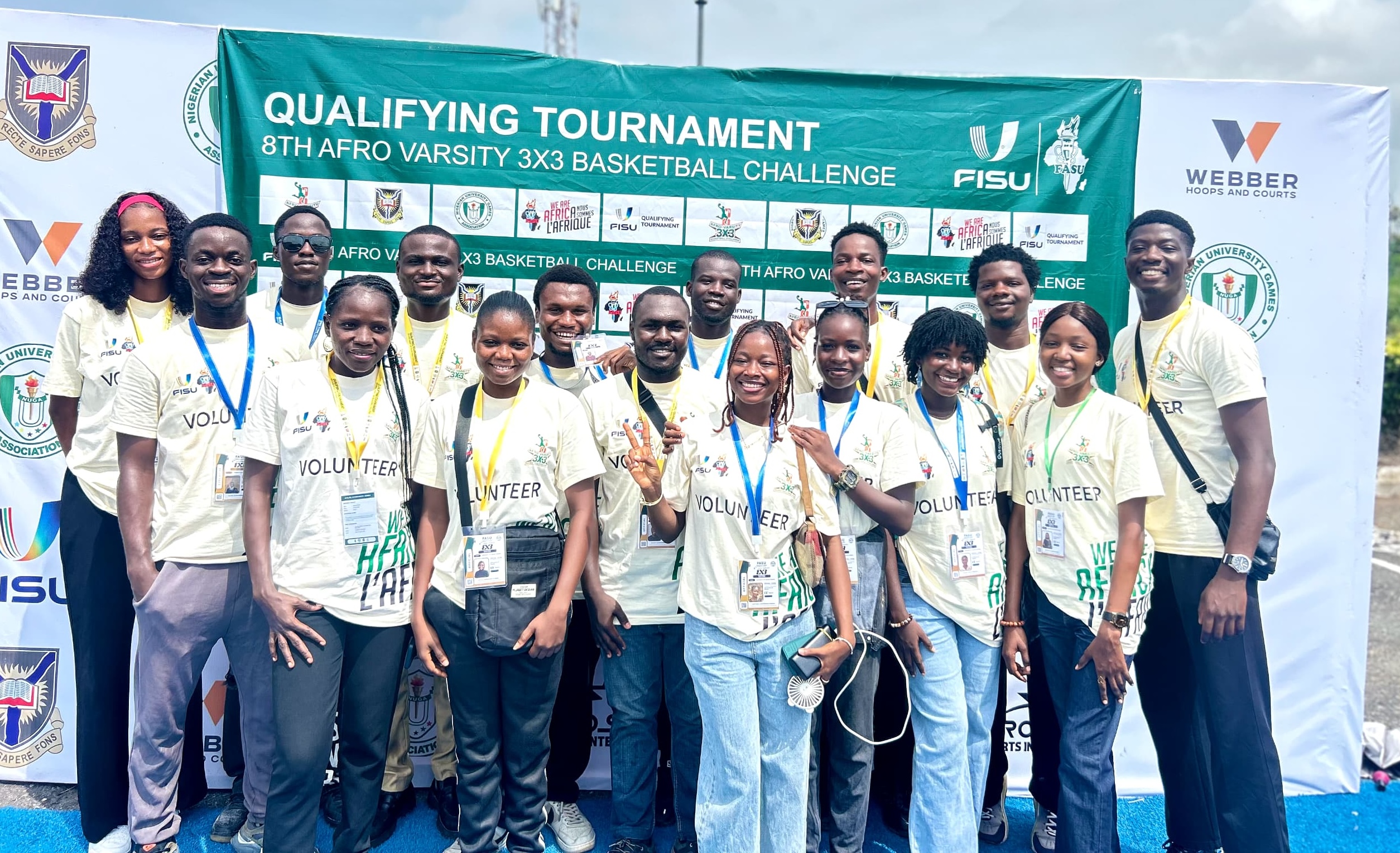
As the final whistle sounded and the celebrations of the tournament champions echoed across the court, another group gathered to reflect on a different kind of victory.
They did not score points or make game-winning shots, yet their impact on the FASU AfroVarsity 3×3 Basketball Challenge was impossible to miss.
Over two days, student volunteers formed a high-impact workforce that helped keep the championship running smoothly. They supported event operations, handled media responsibilities, solved problems behind the scenes, and gained lessons that may ultimately shape their futures in sports administration, management, and business.
For many of them, the tournament was more than a volunteer assignment. It became a classroom, a development hub, and, most importantly, a glimpse into what is possible when young Africans choose to serve within the sports industry.
For Raji Hafiz Ajibola, a returning volunteer and student sports leader from Adekunle Ajasin University, every photograph captured a story. As a member of the Media and Communications team, his role revolved around documenting moments that would outlive the tournament itself while navigating the pressures that come with covering a fast-paced sporting event.
Having volunteered at previous competitions, Raji understood that challenges were inevitable. The key, he explained, was learning how to remain composed when multiple demands arise simultaneously.
“You attend to them one after the other, especially using a priority scale,” he said.
To him, the value of volunteers cannot be overstated.
“Without volunteers, there are things that won’t come out very well. Events become easier and faster because of volunteers.”
The highly visible contributions of volunteers throughout the tournament reinforced the truth of his statement.
The championship also provided an opportunity for individuals experiencing sports volunteering for the first time.
When Odetunde Kofoworola arrived at the games, she came seeking experience. A master’s student in Sports Business and Marketing at the University of Ibadan, she served on the courtside operations team. What she discovered was far more rewarding than she anticipated.
“It has been educational and fun at the same time,” she reflected.
Her responsibilities included ensuring activities around the court ran smoothly and that athletes received the support they needed. Along the way, she developed skills in communication, teamwork, and event execution—lessons that no classroom could adequately teach.
For someone aspiring to build a career in sports business, the experience provided valuable exposure to the industry she hopes to join.
Equally significant was what she observed in sports leadership. Seeing women occupy leadership positions within the volunteer structure inspired her own ambitions.
“I really want this for myself,” she admitted.
When asked what she would say to young people considering volunteering, her response was immediate and enthusiastic:
“Just do it. You have nothing to lose. By volunteering, you’ll gain experience, knowledge, and growth.”
Few individuals embodied the long-term impact of volunteering better than Kolawole Esther, who now serves as a FISU Student Ambassador representing Nigeria.
Before the title and responsibility came years of showing up, serving, and learning.
She believes volunteering is one of the most indispensable ingredients of any successful sporting event.
“There is no game without volunteers,” she said, borrowing a phrase she encountered during previous FISU events.
At the AfroVarsity 3×3 Challenge, Esther worked within the Secretariat, one of the busiest units of the tournament. The department was responsible for accreditation, technical meetings, documentation, minute-taking, and much of the administrative work that kept the event functioning effectively.
Like any major sporting event, volunteering came with its challenges.
Reflecting on his experience, Asaye Oluwasegun David shared his perspective. Working in courtside operations and technical support, his responsibilities ranged from assisting officials and referees to verifying scores and supporting athlete welfare.
“The workdays were long, sometimes stretching from early morning until late at night. It is a lot,” he admitted.
Yet despite the demanding nature of the role, David believes many people misunderstand what volunteering truly represents.
Too often, he argued, people focus on the fact that volunteers are not paid. What they fail to recognize is the experience gained, the relationships built, and the opportunities that emerge as a result.
“It is exposure that money cannot easily buy,” he explained.
Throughout the tournament, he interacted with international officials, coaches, and sports administrators from different countries. Those conversations alone, he believes, made the experience worthwhile.
Still, he was candid about areas for improvement. Better planning structures and more efficient operational systems, he suggested, would enhance future events for both athletes and volunteers.
The spirit of volunteering is rooted in service, and few demonstrated that more than Gloria Akinyemi.
Throughout the tournament, she worked across accommodation, hospitality, courtside operations, and even stepped in as an interpreter when the need arose.
Her experience was characterised by constant activity, but what stood out most was the joy she found in serving others.
“If you see me volunteering, you would think they are paying me,” she joked.
One of her favourite memories came from something many might consider ordinary—handing athletes water before and after games.
For Gloria, these moments mattered.
They provided opportunities to encourage players, share smiles, and contribute positively to their overall experience at the tournament.
Across the two days of competition, volunteers arrived ready to serve, but they left with much more than they expected.
They gained new skills, formed new friendships, and expanded their professional networks. Some discovered potential careers in sports administration, while others strengthened ambitions they already held. Nearly all departed with experiences that will remain with them for years to come.
The 8th FASU AfroVarsity 3×3 Basketball Challenge showcased talented student-athletes from across Africa, but it also highlighted an important truth: behind every successful sporting event stands a dedicated army of volunteers whose contributions are invaluable.
They ensure the show goes on. More importantly, they are developing into the next generation of leaders who will help shape the future of African university sport.
Written by Victor Oluwaseun Olabisi