
By Victor Oluwaseun Olabisi
A few weeks before Cairo 2026, Ghanaian quarter-miler Mordecai Owusu Acheampong was struggling mentally. With support from counselling, he rebuilt his confidence, trusted his race plan and delivered a composed performance to become an All Africa University Games champion.
With 150 metres remaining in the men’s 400m final, Mordecai Owusu Acheampong began to make his move.
The University of Ghana student had resisted the temptation to chase the early leaders. He did not panic when the athletes around him moved ahead. Instead, he remained composed, stayed within touching distance of the front and waited for the moment he believed would come.
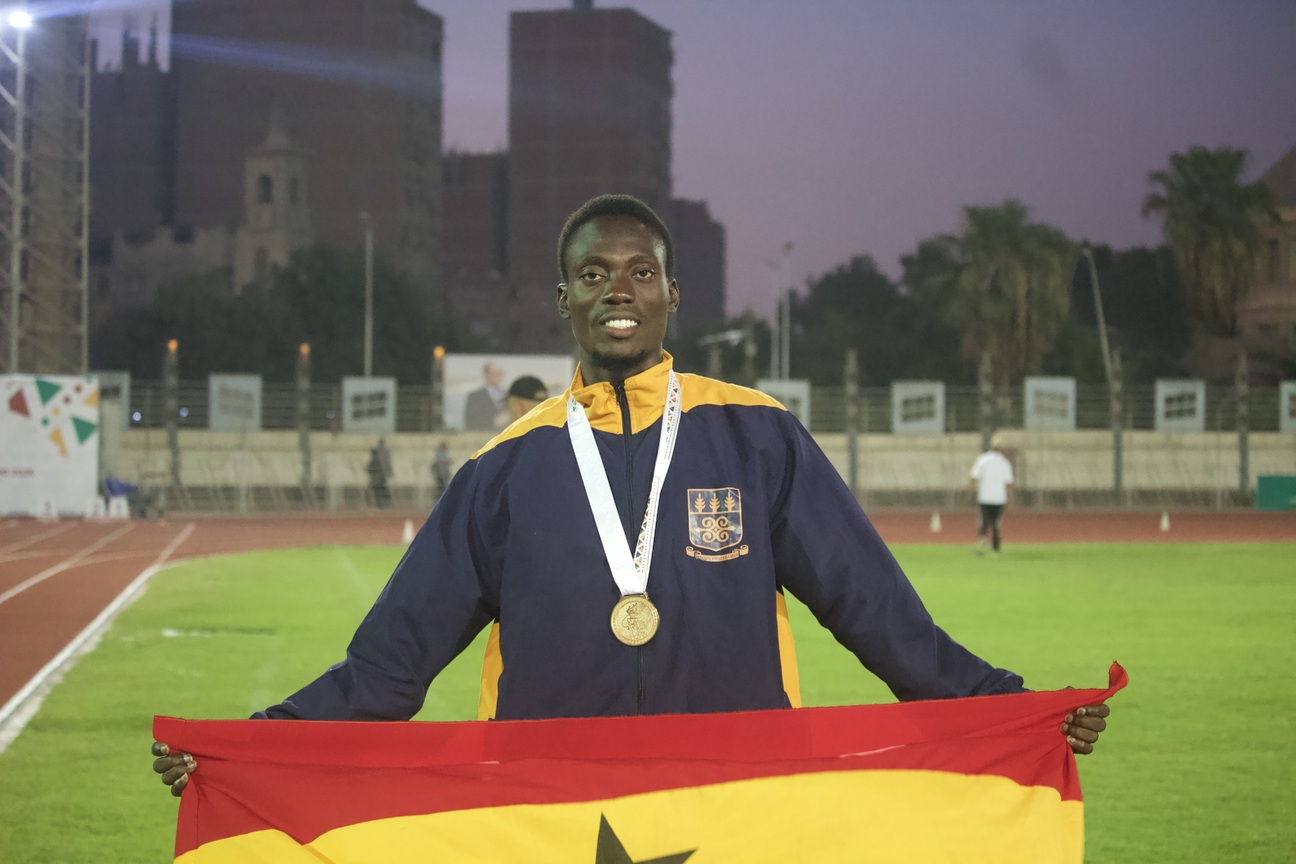
When it arrived, Acheampong accelerated through the field and crossed the finish line first in 46.36 seconds, securing the men’s 400m gold medal at the 12th All Africa University Games in Cairo.
The victory was the product of a well-executed race plan, but it also represented something more personal. Just a few weeks earlier, Acheampong had been struggling with his mental wellbeing and confidence.
“I was quite down. I was very, very mentally weak,” he recalled.
For a 400m runner preparing for a major competition, the timing was far from ideal. The physical work had been completed, but confidence, concentration and the ability to trust his preparation had become more difficult.
Counselling proved instrumental in helping him regain his mental strength. After one or two sessions, Acheampong began to feel more confident and better prepared to compete.
“I just boosted my mental strength and my mentality generally,” he said.
Trusting the race plan
What followed in Cairo was one of the most composed performances of his career.
Acheampong knew the quality of the athletes around him, but he also understood what he was capable of producing.
“I know what I have in me. I know my capabilities,” he said.
His plan was clear: remain relaxed, maintain a position among the leading four athletes during the opening 250 metres and then increase his pace over the final 150 metres.
“My plan was to just stick to it, run relaxed, stay behind them and increase my pace in the last 150 metres,” he explained.
It required patience and restraint. In an event where athletes can quickly lose ground by reacting too early—or exhaust themselves by attacking too soon—Acheampong remained committed to his strategy.
The final 150 metres became his territory. He found another gear, moved through the field and completed the comeback in 46.36 seconds.
The performance was consistent with the level he had reached during the season. World Athletics records a personal best of 46.02 seconds for Acheampong, set at the Cape Coast Sports Stadium in March 2026. At that stage of the year, Ghana Athletics ranked him sixth on the country’s 400m performance list.
His progress has been visible over several seasons. In 2025, Acheampong ran 46.63 seconds at the University of Ghana Sports Stadium, representing a significant improvement on his earlier career marks. By March 2026, he had lowered his personal best to 46.02 seconds and established himself among Ghana’s leading quarter-milers.
He also won the senior men’s 400m at the Accra Open Championships in April 2026, having previously recorded a 46.24-second victory in Ghana’s Elite Schools League.
Acheampong’s journey, however, began long before those performances. He appeared in the men’s 400m heats at the 2023 Ghana National Open Championships, representing Inspired by Sports Academy. By 2024, he was competing nationally for the University of Ghana and becoming increasingly prominent within the university athletics circuit.
A medal that means more
Cairo 2026 was Acheampong’s first FASU Games, giving the victory significance beyond the finishing time.
After crossing the line, he immediately reached for the Ghanaian flag.
“It meant a lot to me,” he said.
The gesture was both a celebration of his country and an acknowledgement of the people who supported him through the difficult periods when his progress was less visible. Acheampong credited his coach, directors, family and the University of Ghana for helping him reach the Games.
Despite the attention that followed his victory, he does not want the Cairo gold medal to become the high point of his university athletics career. His focus has already shifted towards improving his performance.
“I just want to improve more. I just want to be better—just improve upon the time,” he said.
The 21-year-old Administration student also intends to pursue athletics professionally, an ambition that will demand the same combination of discipline, patience and mental strength that carried him through the final metres in Cairo.
For Acheampong, the most important breakthrough may not be reflected on the stopwatch. He arrived at the Games following a period in which he did not feel mentally strong. Through counselling, preparation and renewed confidence, he found clarity and trusted himself again.
That belief helped him remain patient when others moved ahead, attack when the decisive moment arrived and leave Cairo as an All Africa University Games champion.