
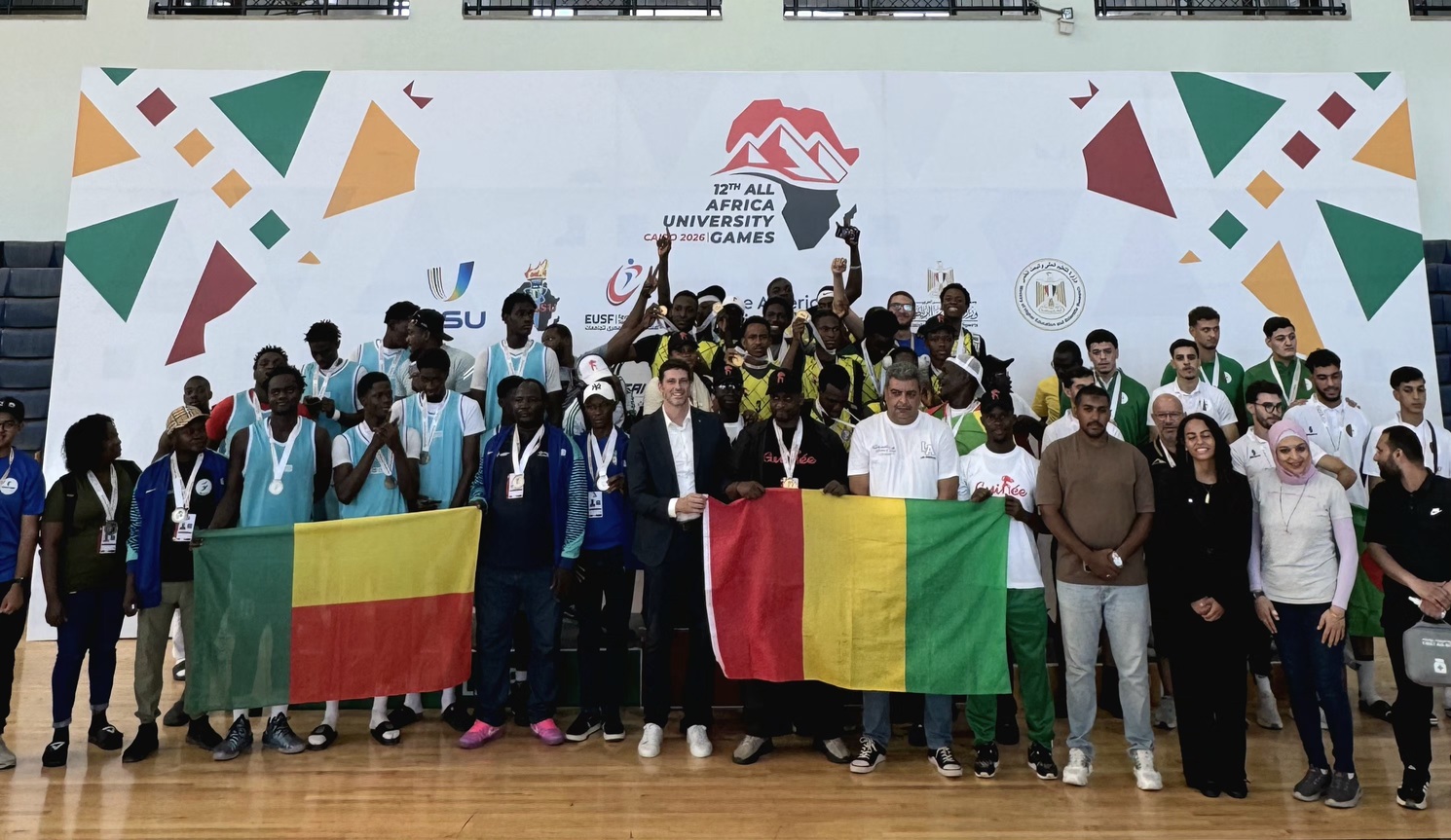
After losing 63–49 to Université de Parakou earlier in the tournament, Institut Supérieur de Technologie de Mamou returned with a better understanding of its opponent—and a different result when the men’s basketball gold medal was at stake.
When Institut Supérieur de Technologie de Mamou and Université de Parakou met for the second time at the 12th All Africa University Games, the stakes had changed.
Their first encounter ended in a 63–49 victory for the Beninese side. In the final, however, ISTM overturned that defeat with an 80–67 triumph to secure Guinea’s men’s basketball gold medal in Cairo.
At the centre of the turnaround were two guards at different stages of their university careers.
Baraka Djibril Kaba, a third-year student, had spent two years with the ISTM team and already understood the demands of university basketball. Saïdou Oumar Diallo, a first-year student from Conakry, was completing his first season with the team and competing outside Guinea for the first time.
Both arrived in Cairo with the same objective. Both left as African university champions.
“It’s the best feeling ever,” Diallo said after the final. “For me, it’s my first time playing outside Guinea, and for almost everyone on the team, it’s also their first time. It’s a very, very good feeling.”
As the final seconds disappeared from the clock, the scoreboard confirmed the scale of their achievement: ISTM 80, Université de Parakou 67.
Across the court, the Parakou players were left to process the disappointment of losing the final. On the other side, the Guineans celebrated the conclusion of a journey that had begun months earlier at home.
FROM GUINEAN CHAMPIONS TO AFRICAN CHAMPIONS
ISTM did not arrive in Cairo as an unknown team. The institution qualified as the men’s basketball champion of the 10th Jeux Universitaires de Guinée, held earlier in 2026.
Its domestic campaign had already established the team as one of Guinea’s leading university basketball sides.
ISTM opened the national competition with a 72–51 victory over Université Internationale Collège de Guinée before defeating the Institut Supérieur de Commerce et d’Administration des Entreprises en Guinée 50–44. A narrow 34–32 win against Université Général Lansana Conté de Sonfonia completed an unbeaten group-stage campaign.
The team then defeated the Institut Supérieur des Arts Mory Kanté de Dubréka 50–25 in the quarter-finals before overcoming Université Mercure International in the final to claim the national university title.
That success earned ISTM its place at Cairo 2026, where the scale of the challenge was considerably greater. The 12th All Africa University Games brought together 82 universities from 18 African countries for competition across conventional, Para and recreational sports.
Guinea travelled to Egypt with a 72-member delegation, including 65 representatives from three higher education institutions: Université Général Lansana Conté de Sonfonia, Institut Supérieur de Technologie de Mamou and Université Julius Nyerere de Kankan.
For ISTM, Cairo offered the opportunity to discover whether Guinea’s university champions could compete successfully at continental level.
AN OPENING WIN BUILDS BELIEF
The first test came against the American University in Cairo, with ISTM opening its campaign by defeating the host institution 62–48.
For Diallo, that result immediately changed the mood within the team.
“It felt very, very good because it was the first game,” he said. “It gave us confidence and showed us that we could win the Cup.”
That confidence was soon tested when ISTM faced Université de Parakou—the team it would eventually meet again in the final.
The first encounter did not go Guinea’s way, as Parakou secured a 63–49 victory. The defeat would become significant later, giving ISTM an opportunity to study its opponent before the gold-medal rematch.
LEARNING FROM DEFEAT
Kaba described the final as more than another basketball game.
“We came to take our revenge,” he said.
The road to the rematch had not been straightforward. ISTM had to manage fatigue, pressure and the demands of playing matches in quick succession.
Diallo believes the circumstances surrounding the first defeat prevented Parakou from seeing the Guinean team at its best.
“We didn’t play at 100 per cent in our first game against them because we were very tired,” he explained. “We had played against AUC and then, ten hours later, we played against Benin. We were very tired.”
Although the schedule placed ISTM under considerable physical strain, the match also gave the Guineans an opportunity to understand Parakou’s strengths, movement and style of play.
“They didn’t know who was better in our team, who was good and who was not,” Diallo said. “I think that helped us.”
By the time the final arrived, ISTM had a clearer understanding of its opponent and greater confidence in the depth of its squad.
“Everyone was in this game—from the first player to the 12th player,” Diallo said.
That collective contribution became one of the defining features of Guinea’s performance.
STAYING COMPOSED UNDER PRESSURE
The final was not entirely under Guinea’s control.
There were periods when Parakou responded to every ISTM score with one of its own. The margin narrowed on several occasions, creating the possibility of a tense finish.
During those moments, the Guinean players and coaching staff remained composed. For Diallo, the communication among the team was as important as any individual play.
“The communication was great because we encouraged each other,” he said. “Everyone has talent. Everyone can do something, and we encouraged everyone so that we could do our best.”
Diallo began playing basketball in 2019. The first-year student from Conakry plays primarily as a shooting guard but can also operate at point guard.
His first season in university basketball has now given him an experience few first-year student-athletes could have anticipated. He travelled to Egypt as a university basketball player and will return to Guinea as a continental champion.
“We were champions in Guinea, and now we are champions in Africa,” he said.
TWO MONTHS OF DEMANDING PREPARATION
For Kaba, the victory was the reward for a longer journey.
The third-year student has spent two years with the ISTM team, playing primarily as a shooting guard. Before stepping onto the court for the final in Cairo, he had already experienced the progression from domestic university basketball to continental competition.
Preparing for that step required nearly two months of intensive training.
“I’m not going to lie—it was so hard,” Kaba said. “It was a rigorous training camp.”
The work completed during camp was repeatedly tested once the competition began. ISTM faced unfamiliar opponents, a demanding schedule and the physical pressure of competing against universities from across Africa.
However, by the time the final arrived, the Guineans could rely on qualities developed away from the spotlight: physical conditioning, familiarity with one another and confidence in their preparation.
GETTING IT RIGHT WHEN IT MATTERED MOST
Université de Parakou entered the final unbeaten, having recorded four consecutive victories. Its run included an 87–53 win over Higher Education Institutes, a narrow 73–71 victory against AUC and a commanding 96–52 semi-final win over the University of Canada.
ISTM, however, carried a different memory of its opponent.
The Guineans had already lost to Parakou earlier in the tournament. When the teams returned to the court for the title decider on 16 September, ISTM was not only playing for a gold medal; it was confronting the only team that had already shown it how defeat felt in Cairo.
This time, Guinea found the answer.
The 80–67 victory overturned Parakou’s earlier 14-point win and secured the men’s basketball title for ISTM.
“I’m feeling good. I feel happy because we put in a lot of work to win this Cup,” Kaba said.
The statement was simple, but the journey behind it was anything but.
The work began in Guinea, where ISTM won the national university championship and earned the right to represent the country. It continued through a demanding training camp and a difficult continental competition.
The defeat to Parakou tested the team. The final gave it an opportunity to respond.
When the stakes were highest, the same ISTM team that had lost 63–49 returned to defeat its opponent 80–67.
LOOKING BEYOND CAIRO
For Diallo, the medal carries particular significance. Cairo was his first opportunity to play basketball outside Guinea, and the same was true for many of his teammates.
“It’s the best feeling ever,” he said. “For me, it’s the first time I have played outside Guinea.”
Kaba, meanwhile, is already looking beyond the celebrations. His next ambition extends beyond African university basketball: he wants ISTM to represent Guinea and Africa successfully at the University Basketball World Cup.
“We need a World Cup,” he said. “For the next World Cup, we need to work for it—for us and for Africa.”
It is an ambitious target for a young university team whose players are still developing their careers. Yet that ambition reflects the journey that brought ISTM to Cairo.
The team first had to become champion at home. It then had to test itself against the continent, recover from defeat and return to overcome the same opponent when the gold medal was on the line.
Kaba and Diallo may be at different stages of their university careers, but Cairo has given both players a defining achievement.
For Diallo, who has played basketball since 2019 and is only beginning his university journey, the title feels like a starting point rather than a destination. For Kaba, already two years into his time with the team, the medal represents the reward for a longer period of preparation and commitment.
Guinea’s basketball contingent will return home with pride, satisfaction and a continental title. More importantly, its success gives young players across the country something tangible to believe in.
For ISTM and Guinean university basketball, continental excellence is no longer simply an ambition. It is now a reality.
By Victor Oluwaseun Olabisi